This page looks at some important, key facts for comparing the physical complexity of the neuroscience general morphology of neurons and for understanding its general complexity.
(Morphology: The branch of biology that deals with the form of living organisms, and with relationships between their structures.)
NEUROSCIENCE COMPARATIVE FACTS to the UNIVERSE
The Milky Way is between 13-17 billion years old barred spiral galaxy 100,000–120,000 light-years in diameter and 1000 ly thick containing 200–400 billion (ten to 9) stars. It may contain at least as many planets.
In 1999, the Hubble Space Telescope estimated that there were 125 billion (ten to 9) galaxies in the universe, and recently with the new camera HST has observed 3,000 visible galaxies. (This HST research established that the universe is expanding and thus proving the universe was created at one point in time about 14 billion years ago!)
So how does the brain’s complexity compared to the universe?
Each person has:
– 100 billion neurons (ten to 9) (= 1 x 10 to the 11) cells
– 100 trillion dendrites (ten to 12) (= 1 x 10 to the 14) Connectomes
– 10 billion mitochondria (ten to 8) (= 1 x 10 to the 9)
– 20,000 genes
– 20 types of amino acids
10,000 average (ten to 3) dendrites/neuron with a possibility of 70,000 connectome dendrites for an individual neuron cell!


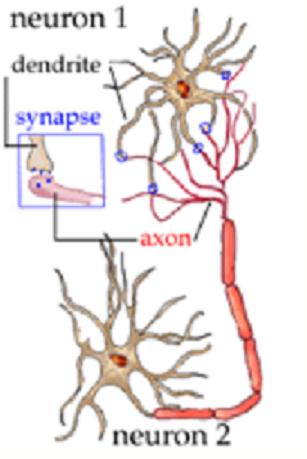
Connected Neurons with Myelinated Axon
Implies your brain is more complex than our entire universe (without counting people)!
And unlike the galaxies and suns and planets that have little direct connections – neurons has more connections and cross-connections of dendrites than anything known in the universe!
A human brain is like a car that is never turned off!
It runs on a combination of electrical or chemical or electrochemical components that continuously consumes energy. The brain consumes about 25% of all the oxygen you breath – it’s a real energy hog since is running constantly. There have been cases where a person’s body systems have been completely stopped functioning – but when their brain had been restarted – they still remembered everything they originally knew!
Thus, the brain has a non-volatile memory similar to a flash, thumb drive but each neuron is like a mini-CPU.
One general conclusion is that it is impossible to created a computer system that can emulate the brain. This is very similar to the issue with E = Mc2 in that if would take an infinite amount of energy or all the energy in the universe to accelerate the smallest particle you can imagine to the speed of light. To add to this brain complexity issue is that the brain can grow new neurons in less than 2 minutes and that continuously creates is new connection and reconnection of dendrites. Thus, the brain of one second ago is different from the brain of the now moment – no computer system can or will ever be able to accurately track what is in your brain memory – moment to moment!
How Active is the Brain?
There can be 40 billion firings per moment in the brain.
However, we are typically are only consciously aware of about 2,000.
Further more, these brain processing activities are constantly redefining (rewiring) and reconnecting dendrites are occurring in sub-unconscious manner.
How Responsive is the Brain?
A neuron can do two basic actions: excite or inhibit.
There are two basic types of neuron: unsheathed (non-myelinated) or sheathed (myelinated)
An unsheathed neuron fires in 1 to 2 mile/hour.
a sheathed, 200 miles/hour or about 200 times faster.
The longer neurons can be 3 feet long; and the more neuron that need to fire (sequenced) the long the response time.
Converting these two measure form miles/hour to feet/second you get:
- unsheathed – 0.300 foot/second
- unsheathed – 0.003 foot/second – real fast!
Additionally, a simple neuron cluster that does a basic “chunk” brain cell action such as raising your hand – you can expect a faster response of 0.003 seconds.
Where as, to strike some one takes about 3 basic movements that requires a couple of basic “chunk” brain cell action plus and integrated/timing movement could take 0.030 movement for unsheathed neurons.
Thus, it is better to block a strike than to match a strike – giving you more time to move away from a conflict situation. Also, you will avoid provoking an adrenal rush allowing to stay in control of your follow-on actions.
Further more, the more you mediate/prayer the quicker your mind flash loads your prayer into your conscious brain, the faster you can make decision and invoke alternate response to avoid conflict – OR – even better, turn the conflict into a more peaceful and friendly encounter.
GENERAL BRAIN INFORMATION
Neuron verses Glia
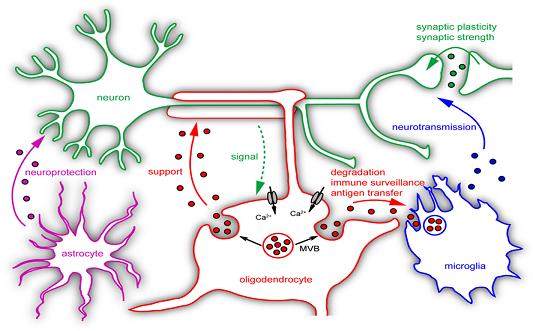
Neuron Glia Framework
- Neurons use electrochemical processing and are triggering by electrical discharge
- Neurons pass messages via neurotransmitter cells across a synaptic gap (confined space) between an axon and a dendrite
- Neurons that are sheathing can response 200 times faster than unsheathed
- Glia type cells constructs and maintains myelinated sheathing that make neuron fast
- Myelinated neurons are considered mature neurons
- Myelination maturation starts in a fetus at the back side of the brain and moves towards the frontal cortex and this growth process movement occurs until we are about 24 years old
- Glia type cells build new neurons, repairs neurons, supplies nutrients, and clean-up neuron waste including the rewire dendrite connection
- Glia type cells are considered the “other brain” (but at least one other brain has been advanced by theory of Connectome and this other brain is being looked as as the seat of our conscious mind)
- Glia type cells are found through out the body and come in several basic types: astrocyte, Schwann, microglia, oligodendrocytes, and meningeal and ependymal (surface of the brain)
- Glia type cells are intelligent agents that indirectly read neuron activities
- Glia process messages using a mostly chemical message processing and therefore are slower than neurons but can also pass “wireless” message across gaps
- Glia pass messages communicate over large areas in the body
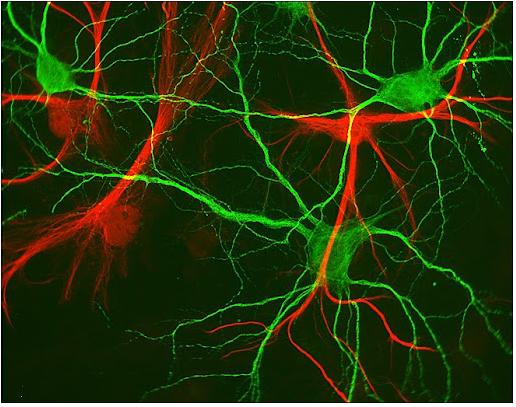
Neuron (green) Glia (red)Stained Image
 Plan4Childhood